MAJOR PROJECT 2
(Week 1 - Week 7)
Aisya Diva Anwagodsa (0365505)
Major Project 2/ Bachelor of Design (Hons) in Creative Media
Table of Content
Previously in the Major Project 1, our group proposed to make a card game that inspired by Indonesian folklores. In this semester, our group still aiming for the same project and below is the expected outcome from our game:
- Packaging
- Manual booklet
- Character cards (40)
- Narrative cards
- Merchandises (Stickers, keychain, and bookmarks)
- Instagram post
- Website
- Posters
From all of the list above, there are some improvement we made from the MP 1 to MP 2 that will be explained in the progress section.
Progress
1. Game system
For the game system, our group decided to make changes, because the gameplay was not challenging at all with no winning condition. That is why we decided to add activation number which enhance the competitiveness in the game. The rule of activation number is simple, the activation number indicates the minimum time of card need to be used before the player withdraw the card. For example, the player got a character card with 3 activation number, means that the player should use the character 3 times before they remove the character from their deck.
2.
Logo
Since the core of this project lies in the gameplay itself, it was important to realign the branding with the game’s personality. Therefore, we developed the logo to better represent Cerita Rakyat as a playful and enjoyable game, while still maintaining a sense of quality and refinement. This approach ensures that the branding feels appropriate and cohesive without changing the whole thing that has been existed.
We also explored several alternatives for the logo mark by utilizing letterforms. However, we concluded that retaining the original mark was more appropriate than disrupting what we already had. The existing logo carries the “soul” of the game, playing an important role in storytelling. It is inspired by the gunungan, which is traditionally used by a dalang (storyteller) in Javanese culture as a symbolic prop to mark scene transitions in a performance. In the context of this game, the gunungan also represents the player as someone who holds control over the flow of the story. For this reason, we decided to keep the gunungan and focus on refining other elements instead.
 |
| Fig. 1.1 Logo exploration |
 |
| Fig. 1.2 Logo before and after |
For the typography, we shifted to a simpler style that still conveys an ancient, traditional feel but still approachable. We chose Sutasoma Display for the headings and Sutasoma Text for the tagline. Previously, we used ITC Benguiat for the headings and Neue Kabel for the tagline.
3. Card layout & patterns
Week 1 is where we started to distribute the task and getting brief from our lecturer regarding the rest of the semester. In this semester we don't have much time because there is so many things to do, especially for our group since we made a lot of changes. In week one, I started to make element for the card, which is the batik pattern that will be used in the character cards.
Since our folklores are drawn from five major regions of Indonesia, we developed five distinct patterns inspired by the batik traditions of each region. Below is the list of regions represented in our designs and the meaning of element used:
- Java: royalty
- Sumatra: prosperity
- Sulawesi: ancestors & costrology
- Kalimantan: protection & unity
- Papua: symbolizing spirits
 |
| Fig. 1.3 Batik pattern sketch by Sheryne |
 |
| Fig. 1.4 Batik pattern digitalization by Aisya |
Overall, most of the patterns were relatively easy to digitize. However, the Kalimantan pattern posed a greater challenge due to its unique form, making it more difficult to arrange into a cohesive and structured pattern. As a result, I made slight adjustments to the shape while ensuring that its essential meaning and cultural significance were preserved.
Below is the final result of each patterns:
 |
| Fig. 1.5 Batik Jawa developed by Sheryne |
 |
| Fig. 1.6 Batik Sumatra developed by Aisya |
 |
| Fig. 1.7 Batik Papua developed by Aisya |
 |
| Fig. 1.8 Batik Kalimantan developed by Aisya |
 |
| Fig. 1.9 Batik Sulawesi developed by Aisya |
After finalizing the patterns, I proceeded with the card layout, which was developed from the previous semester. The character cards are designed to include the character’s name and key traits, making it easier for players to narrate and build their own version of the story.
 |
| Fig. 1.10 Card layout development by Aisya & Lizzie |
The first version was developed during the previous stage. The design incorporates elements from our icon, Gunungan, including twirl motifs that represent stories flowing like a swirl. It also includes patterns that represent the region where the story originates. Our main concern is the twirl motifs that takes up the space for the description as the container was quite big and covered a lot of the illustration. Other than that, we weren’t sure how long our texts would be.
The second version was improved by removing details that could distract from the main focus of the card, particularly in the card description container, where the twirl elements were removed. We reduced the size of the container and ensured the descriptions won’t be too long.
The final version focuses more on the illustration by optimizing the space and making the illustration larger. An element to indicate the card activation number was also added in the middle of the container, the activation number is an additional changes that we made this semester to make the game more challenging and more structured, this was done according to the feedback by our respondents in the previous semester. While the card element on the bottom was also reduced in size to make space for the illustration frame to be bigger.
The final layout helps create a clearer flow and better focus on the character, guiding the viewer from the character’s name to the illustration and then to the description.
4. Sketch & Illustration
Meanwhile, the characters and Illustration were made by Sheryne and Ying Ying. In the first two weeks, they still settling up the sketch as the base for the illustration. below are the sketches made by Ying Ying:
 |
| Fig. 1.11 Character sketch by Ying Ying |
The illustration process was also very important, as it serves as the main element across most of our game components (cards, booklet, and website). This means we were only able to proceed with the rest of the components once all the illustrations were completed. In total, we produced 40 illustrations. Our illustrators (Ying Ying & Sheryne) put a lot of effort into this process, with the sketches by Ying Ying and both the line art and coloring handled entirely by Sheryne to ensure a consistent visual appearance.
 |
| Fig.1.12 Character Line art & Sketch by Ying Ying x Sheryne |
During the process, we received several suggestions regarding the coloring of the characters. Ms. Vitya suggested exploring a two-color approach, which could not only save time but also help highlight the characters more effectively. However, after experimenting with this method, we found that it did not align well with our overall branding. We then consulted Mr. Kanan, and he suggested to refine the color palette by using brighter tones and higher contrast, allowing the characters to stand out more strongly within the illustrations.
 |
| Fig.1.13 Character design development by Sheryne |
It can be seen that the changes is gradually getting better and more emphasizing out character, which could enhance the overall experience of the gameplay.
In total, the illustration process took almost the whole semester to finish. But gladly it made it in week 6, so we can proceed to place all of the illustrations in the existed template (cards, book, and website) so everything that needed to be printed out can be done before the presentation day.
5. Book & Cards content
For the book and card content, Lizzie and I worked on it together. For the book, I helped her summarize some of the stories in a Google document and also contributed to brainstorming ideas for the narrative cards. The process took us around one week. However, towards the end of the project, we still hadn’t finished the card content because we found it challenging to make the descriptions feel funny while still staying true to the characters’ original traits.
6. Booklet
For the booklet, lizzie was the one in charge in planning the layout. It had been through few changes from the previous semester. Which can be seen in the layout itself, in the previous semester each page contains one story that make the layout looks crumpled and forcing the space to fit all of the characters from each folklores. So in the new layout, Lizzie utilize one spread for each story that gives more room and not confusing the reader, while the character illustration also changed because in MP1 we put the whole card design to the booklet, which is not effective and make the layout looked too obvious:
 |
| Fig.1.14 Manual book exploration by Lizzie |
Some of the main challenges during the booklet making was mainly adjusting the font size because our booklet size is small (80 mm x 120 mm) which is similar to the card size but slightly wider, another challenge is the layout, especially when it comes to a story that has more than 3 characters, because most of the story has 3 characters only, but there's one story from Papua region (Ampat Raja) that has 5 character involved, but after we discuss and consideration the size of the illustrations were reduced and arrange next to each other and a horizontal line was added to make the layout consistent without disrupting the whole layout that has been established.
 |
| Fig.1.15 Ampat Raja layout by Lizzie |
Additional booklet was also made for the regular packaging that can only fit the cards. So the booklet will only contain the game rules and QR code that will lead to Cerita Rakyat official website that provides information about the folklores.
 |
| Fig.1.16 Mini booklet layout |
7. Packaging
Previously in MP1, our packaging was only developed up to the mockup stage. In this semester, we aimed to produce the physical version. For reference, below is the packaging for this game card:
 |
| Fig.1.17 Packaging mockup MP1 |
As shown in the mockup, the packaging initially only contained two slots for the narrative and character cards. However, in this semester, we made improvements by adding more slots to keep all of the game components more organized. We refer to the version with fours as the special packaging. In MP2, we also introduced an additional version, which is the regular packaging designed to store the cards only.
To simplify, below is the difference between the regular packaging and the special packaging:
Special packaging:
- Contain 3 designated slots for each game components
- Has hourglass
- The material is more solid could secure the game components
- The booklet provided contains summaries of each folklores to help players understand about the character better
Regular packaging:
- More handy
- Only has one slot to keep all of the cards including the small booklet
- Comes with a small booklet only contain game rules and QR code that will lead to Cerita Rakyat's official website so the player can access all of the folklores
Special Packaging
As we already have the base of packaging type that we want to do, which is magnetic rigid box. We just need to figure out how to make the packaging look neat and could have 4 slots with different depth. As we haven't get the physical game components, I did the counting manually by using estimation of card or by looking at the similar material thickness that we wanted to use for the card.
Character card: 30 mm (40 cards)
Narrative card: 15 mm (20 cards)
Booklet: 10 mm
This was according to the potential material that we want to use. An art card with the thickness of 0.75 mm. Before I proceed I make sure that all of the group members were informed regarding this information.
Based on this measurement, I started to make the dieline. According to my experience making the packaging, the most challenging part is the tray die line, because each components have different depth and before make the digital die line I made the die line manually inspired by the packaging from Lizzie's previous project that has the same approach of packaging style, to see whether it could work or not.
 |
| Fig.1.18 Packaging inspo Volume 19 by Lizzie |
 |
| Fig.1.19 Special packaging dieline trial 1 |
 |
| Fig.1.20 Special packaging dieline tray trial 1 |
The concept is to make stages that will hold each component and then put it into a usual magnetic box dieline. Below is the digitalized version of the die line.
 |
| Fig.1.21 Special packaging die line trial 1 |
After I made the die line I proceed to make the mockup using boxboard that has thinner material than rigid box, below is our first prototype:
 |
| Fig.1.22 Prototype |
This prototype was in the real size. The good news is that the die line actually worked, but the bad news is that the box looks like a brownie box (or whatever it is, because it's too long), so me and the rest of the group brainstormed again and make a new layout, which is also challenging because I had to move the hourglass into the bottom of the box, so it would look like this:
 |
| Fig.1.23 Special packaging die line trial 2 |
This die line does look better, but surely it was not the best because the tray need manual adjustment and not efficient, I need to manually adjust it when make the prototype:
Prototype trial 2
The process of making the prototype itself took me almost the 2 weeks, not included with the visual design, so I try to change how the tray work, and come up with this die line, which each of the tray container are separated:
 |
| Fig.1.24 Final die line |
After the dieline was fixed, I made the final prototype to ensure that everything worked as expected. Another challenge during the prototyping process was that we couldn’t find a material that closely matched the one we intended to use for the final packaging. As a result, we used 5 mm corrugated cardboard as a substitute and art card for the tray, but the artcard itself is too hard to fold which cause some trays broken.
.jpeg) |
| Fig.1.25 Prototype trial 3 |
 |
| Fig.1.26 Prototype trial 3 |
To be honest during the prototype making all of us, especially me were confused and over thinking, because we are scared that what if the packaging is not correct? Because we're gonna spend a lot of money on it. So we make many many attempts of adjustments and repeating the prototype making until it was finalized and we are sure that it will be okay. Once the prototype settled, I proceed to make a the design, which is not taking too much time because I only need to change the logo and added some information at the back of the packaging, however I provided some variation to my group mates and we agreed that the centered part is the better one, so as Ms. Vitya. Because all of the design are centered, works the same with the booklet cover design:
 |
| Fig.1.27 Packaging wrapper layout |
 |
| Fig. 1.28 Special packaging wrapper |
The issue for this design only that the font needs to be smaller so it's consistent with the booklet. meanwhile the logo (word mark) was okay and the gunungan (logomardk) needs to be smaller and centered. Below is the final result of the wrapper:
.png) |
| Fig.1.29 Wrapper Layout |
After finishing the dieline and wrapper, we sent the design to the printing shop. However, the result wasn’t as expected due to some miscommunication. During the visit, not all of us were able to go and check the materials firsthand (I had a physical interview for my internship, so I couldn’t join them). One of us did ask about the material thickness, but the printing shop couldn’t give an exact measurement. They mentioned it was 5 mm, but it turned out to be thinner. Previously, we had used a 5 mm material, and this one felt noticeably less thick in comparison.
Because of that, my friend and I decided to estimate the material size ourselves. Fortunately, the tray was able to fit most of the components. However, since the fit was too exact, it became difficult to take the cards out from the slot. On top of that, the cards were thicker than we initially expected, which made the depth too shallow, especially for the character cards.
To solve the issue with removing the cards, we added a ribbon inside the container so the cards can be pulled out more easily.
 |
| Fig.1.30 Card overflow |
 |
| Fig.1.31 The card too fit |
Another issue that we received is that the narrative card is slightly bigger than the character card, which make it hard to pulled out from the tray.
 |
| Fig.1.32 Attached ribbon to pull out the cards |
How does the ribbon help to pull out the cards
Regular Packaging
Unlike the special packaging, the regular packaging was easier to make and work. Initially we are planning to use the same material as the special packaging to give the high quality feel to the packaging, but due to budget constraints, we need to change the model of the packaging last minute, but in here I will share both of the process of the regular packaging.
Initially, we wanted to make the regular packaging has a similar structure to a cigarette packaging like shown below:
 |
| Fig.1.33 Initial idea of regular packaging |
But after digging some more, we found an interesting packaging structure that is more aligned to our approach, which is elegant and simple, but still approachable as bellow:
 |
| Fig.1.34 Final structure |
Through the picture I analyzed the structure and apply it to our design. But before that I measured the card and the material first to ensure that the packaging could work perfectly once it's done.
 |
| Fig.1.35 Measuring the packaging |
After make sure that the measurement is correct, I started to build the die line on Illustrator and make the prototype out of it using a box board since we could not find the similar material with rigid box material (chip board):
 |
| Fig.1.36 Die line |
 |
| Fig.1.37 Regular packaging prototype |
The next step is to make the design, since we already have the special box design, we just need to replicate the design on the regular packaging, and adjusted the font following the size of the packaging.
 |
| Fig.1.38 Final Design |
Meanwhile, as mentioned earlier, our limited budget prevented us from producing the regular packaging. Because of that, I had to create a new dieline. It only took a few minutes since it was a standard layout and I just needed to transfer the design.
Spending the money was honestly quite overwhelming, and I also felt a bit sad because the effort we had put into the original packaging for weeks couldn’t fully be realized. But in the end, we had to be realistic. As long as the special packaging was completed (since that was our priority) it was still a meaningful outcome.
 |
| Fig.1.39 Regular packaging die line |
Above was the initial design, but Lizzie changed the layout and added some words to make the back of it look less empty.
 |
| Fig.1.40 Final regular packaging |
Packaging mockups
For the mockups I used adobe illustrator and photoshop to customize the design of the packaging, because we cannot find an exact model of it, especially for the tray mockup.
 |
| Fig.1.41 Special Packaging mockup |
 |
| Fig.1.42 Regular packaging mockup |
8. Merchandises
 |
| Fig.1.43 Merch Progress |
Some of the merchandise we created includes stickers, bookmarks, and keychains. For these items, we adapted existing illustrations into merch designs. Below is a detailed description:
Chibi Stickers and Keychains (prepared by Ying Ying)
The chibi stickers and keychains were based on existing folklore characters, redesigned in a cuter style with a meme-like vibe to make them more fun and relatable. To ensure consistency with the overall branding, Ying Ying incorporated a key feature from Sheryne’s illustrations, specifically the eye style, into the designs.
Logo Keychain, Bookmark and Envelope Bundle (prepared by Lizzie)
Lizzie adapted the logo into a keychain design and also developed it into a bookmark. We chose a bookmark because it connects well with the storytelling aspect of our game. In addition, Lizzie created the dieline for the envelope, which is used to hold the merch bundle. This idea was suggested by Ms. Vitya to make our merchandise offering more varied.
Stamp Stickers (prepared by Sheryne)
The stamp stickers are adaptations of the illustrations into stamp-shaped designs. These stickers are mainly used to decorate the envelope for the merch bundle.
9. Instagram content
 |
| Fig.1.44 Cerita Rakyat Instagram page |
While working on the project, we also prepared our social media presence, specifically Instagram content. In this process, the whole team was involved in brainstorming ideas, while Lizzie was in charge of developing the design and executing them. Below are some initial plans for the instagram post:
- 3 announcement post
- 1 trivia post
- Meme style post (RIP ... you would love)
- Behind the team
- Illustration process post
- Introduction post
- Logo explanation post
However, as we progressed, Lizzie suggested adding more content, including photographs, to make the Instagram feed feel more balanced and not too focused on visual graphics alone.
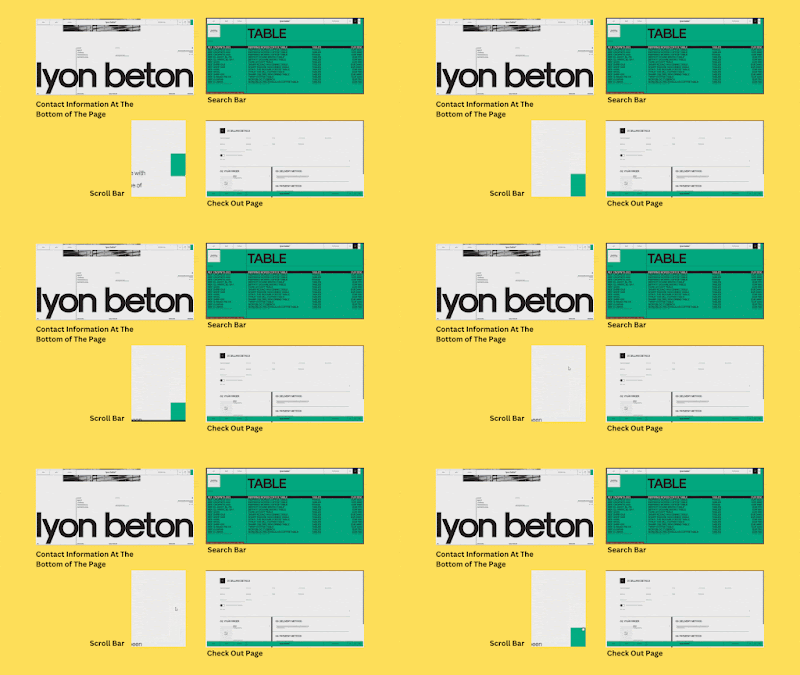
10. Website
 |
| Fig.1.45 Website layout development |
The website development process was also quite challenging, as it was our group’s first time using Framer. During the process, Sheryne worked together with Ying Ying to develop the website.
Our website focuses on providing information about the game. The content includes:
- Introduction to cerita rakyat
- Information about the regions of the folklores
- The folklore stories
- How to play the game
- A footer that contains information about the brand
One of the main challenges I observed was making the website interactive and ensuring that all buttons functioned properly. Up until the day of our presentation, there were still some buttons that did not work as expected. This seemed to be a software-related issue, as after the presentation, the buttons worked correctly, even though we had tested them beforehand.
11. Promotional poster
For the promotional poster, me and Sheryne was in charge. We created one poster each, the first poster is to highlight the game itself while the second one is to promote the special packaging, which I took.
To make the special packaging poster I had to take some pictures from the internet (the exact product that we bought) as a mockup which I will put the credit under the progress documentation, because that time our components haven't finish.
 |
| Fig.1.46 Special packaging poster |
Image source:
Final Result
Week 1
- Make sure to establish the brand identity by week 1 if there's any changes needed, this including the logo refinement and tone settings.
- Allocated 2 weeks for producing the physical packaging.
- The two packagings idea was approved.
- The font thickness in the booklet needs to be adjusted, to make it consistent.
Week 2 (10/2/26)
- The rigid box idea is good, but the material need to be thicker (5 mm), and make sure to check out some list of the printing shops to ensure that our group knows which printing shop that can produce the packaging and printing components before the presentation week, because we have limited time (week 3 we don't have class due to Chinese New Year.
- Try to use two color for the illustration to emphasize the character because the current color palette make the overall illustration kinda looked childish.
- For the packaging, add information such as the list of folklores to give information to the customers about what they would expect to get from the product.
Week 2 (12/2/26) Another consultation with Mr. Kanan
- The card layout should emphasize the illustration, so make the illustration frame bigger and use brighter and contrast color to make the focus on the character itself.
Week 3
CNY holiday
Week 4
- The booklet layout looks nice overall.
- Ensure that the leading properly set (especially on the information section next to table of content).
- Check the use of full stop in each paragraphs, to make it consistent (can use period or not, but it has to be the same for all paragraphs).
- For the chibi style merchandise, adapt one feature from the original illustration to maintain consistency.
- For the packaging, the font needs to be in a similar size with the booklet and better to put information in the center to make it consistent.
Week 5
Make sure that the website contains information of Cerita Rakyat (the back story) to introduce the brand itself not only the product.
For the merchandise can make a bundle (put different items in an envelope) to give variations, and give a proper impression of the brand.
Week 6
Overall, the branding direction and process are good.
The changes of regular packaging due to budget constraints was approved.
Reflection
Experience
project is really a roller coaster for me. Starting something that we had left for a while does trigger a bit of boredom and doubt. I sometimes question myself whether we did the right thing in the previous semester or not, because along the way there are always thoughts like “Are we gonna make it?” or “Will the game work?” Thinking back, I realize it was the challenges that made me overthink.
Despite all of my doubts, I am really grateful to have team members who are supportive and believe in our project. That support makes me feel more positive and helps me keep going. Also, it felt hard because we had to figure out everything from scratch, since we did not have a strong foundation before. But here we are, we finally made it. I am really grateful that all of my group members encouraged me to focus on my part, especially the packaging, because it took weeks and I was scared that it would not turn out as we expected.
Even though there were minor errors in the end and the printing shop kind of let us down, I am still proud to say that our improvisation skills are strong. I am also glad that my team is always open to ideas. Even when the ideas sound weird at first, they still try to understand. I really appreciate that.
Observation
My biggest realization in this group project is time management. I know it sounds cliché and has been mentioned many times in reflections, but what I really want to highlight is the time alignment among group members.
During the process, each of us had different working timelines. Some of us are morning people, while others start working at 5 pm and stay until 6 am. Because of this, idea distribution was not always balanced, especially during moments when our brains were working at their best but not everyone was present to brainstorm together.
We still managed to work things out, even though we sometimes had to re explain ideas or missed some information because those who brainstormed forgot to share everything. From this, I learned that having a clear schedule is very important to optimize the results.
Findings
Having strong conviction is very important in a group project. I learned that when working in a group, there will always be different thoughts and opinions. When doubts appear, each member should remind one another to stay aligned with the foundation of the project. If not, it can disrupt the workflow.
This also happened in our group. Like I mentioned earlier, I had doubts at the beginning, and when I heard others expressing doubts, it validated my feelings. At some point, we became unsure and started thinking about changing the idea entirely, which made me lose some spark in the project. But I am glad that I have group mates who support each other and remind one another that our game is good enough. In the end, it worked and everything turned out well.

.gif)
Comments
Post a Comment